
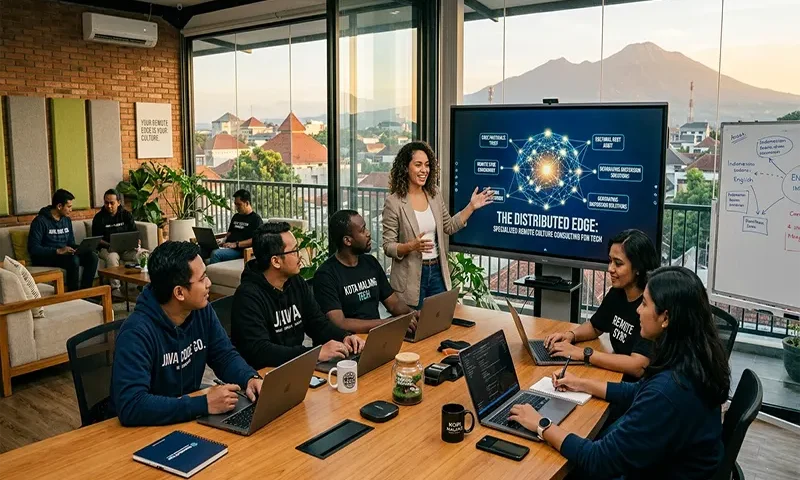
In 2026, the debate over “remote vs. office” has matured into a tactical reality. While 30% of global firms have reverted to full-time office mandates to combat “cultural debt,” the world’s most agile tech companies have doubled down on a distributed-first model. However, being distributed is no longer just about Slack and Zoom; it’s about architecting a high-performance ecosystem where geography is irrelevant to output.
Specialized remote work culture consulting has emerged as a critical service for tech firms that want to scale without losing their “soul” or their speed. This 1,000-word guide explores the consulting models that are driving the next era of distributed tech.
1. The 2026 Landscape: Solving for “Cultural Debt”
Many tech companies that went remote in 2020 are now facing Cultural Debt—the accumulated friction of broken processes, siloed communication, and eroding trust. Consulting services in 2026 focus on three primary pain points:
- The Pilot Trap: Companies that have the tools but haven’t redesigned their workflows to be async-native.
- The AI Integration Gap: Managing “Human-Agent” teams where AI agents now handle up to 40% of routine technical tasks.
- Isolation & Retention: Combatting the 70% of remote workers who cite “lack of connection” as their primary reason for churn.
2. Service Model 1: The “Async-First” Architect
The most profitable consulting niche is transforming synchronous, meeting-heavy cultures into Async-First powerhouses. Consultants in this space don’t just suggest tools; they redesign the company’s operating system.
Core Deliverables:
- The Internal Handbook: Creating a “Single Source of Truth” (SSOT) where every decision, process, and roadmap is documented and searchable.
- Communication Norms: Establishing “Response Time SLAs” (e.g., 4 hours for Slack, 24 hours for Email) to protect deep-work blocks for engineers.
- Meeting Audits: Reducing “status update” meetings by 80% through automated reporting and recorded asynchronous video updates (Loom/Descript).
3. Service Model 2: The Human-AI Team Orchestrator
By 2026, distributed tech teams aren’t just composed of humans; they are “Mixed Teams” of developers and Agentic AI. Culture consultants now help leaders manage the psychological and operational shifts of this new workforce.
Strategic Focus:
- Redesigning Handoffs: Mapping out exactly where a human developer hands off a task to an AI agent (and vice versa) to prevent “Dark AI” friction.
- Trust in Data: Consulting on “Disinformation Security”—ensuring remote teams can trust the authorship and accuracy of the AI-generated context they are using.
- Manager Training: Teaching remote leads how to manage output rather than “presence,” using AI-driven performance metrics that respect employee privacy.
4. The Tech Stack for Distributed Excellence
A culture is only as strong as the tools that support it. Consultants are increasingly acting as “Fractional CTOs of Culture,” implementing a standard 2026 stack:
| Tool Category | Purpose | Examples |
| Knowledge Base | The Async “Brain” | Notion, Tettra, Obsidian (Enterprise) |
| Collaboration | Digital Whiteboarding | Miro, FigJam, Canva Whiteboards |
| Social Cohesion | Spontaneous Connection | Donut, Gather.town, Icebreaker |
| Task Orch. | Human-AI Workflow | Linear, Monday (AI-integrated), Jira NextGen |
5. ROI and Financial Frameworks
For a consulting practice, the value proposition is tied directly to Retention and Real Estate.
- Cost Savings: Highlighting the $2,000 to $6,500 saved per employee annually on overhead and facilities.
- Talent Pool Expansion: A distributed model increases female applicants by 15% and underrepresented minority (URM) candidates by 33%—a key KPI for 2026 ESG reporting.
- Productivity Gains: Documenting the 10-20% boost in output when developers are freed from the “Collaborative Friction” of an open-office environment.
Pricing Frameworks:
- Retainer-Based: $3,000 – $7,000/month for ongoing culture “tuning” and manager coaching.
- Project-Based: $15,000 – $50,000 for a 3-month “Distributed Transformation” project.
Strategic Note: The “Medicated” Office Mandate
Consultants must be aware of the “Hybrid Resistance.” In 2026, 40% of workers say they would take a pay cut to stay remote. When a tech firm issues an office mandate, it effectively imposes a “Flexibility Tax” on its employees. Consultants should help these firms calculate the hidden cost of mandates: higher salary requirements, longer time-to-hire, and the loss of “top-tier” talent to fully distributed competitors.
6. Social Engineering: Building Trust Without Proximity
In a co-located office, trust is built in the breakroom. In a distributed company, trust must be engineered.
- Virtual Rituals: Implementing “Interest-Based Clubs” (e.g., #gaming, #parenting, #fitness) to humanize colleagues across time zones.
- The Offsite Strategy: Designing twice-yearly “High-Impact Offsites.” These are not for work; they are for building the social capital that will be “spent” during remote work for the rest of the year.
- Psychological Safety: Using anonymous, AI-analyzed sentiment tools to catch disengagement before it leads to a resignation.
7. The Future-Proof Tech Culture
The most successful distributed tech companies of 2026 are those that have stopped trying to “recreate the office” online. Instead, they have leaned into the unique advantages of remote work: deep focus, global diversity, and autonomous agency.
Specialized remote culture consulting is the bridge that helps companies cross from “surviving remote” to “thriving distributed.” By selling outcomes—increased velocity, lower churn, and a scalable global culture—consultants are the architects of the new Silicon Valley, which is no longer a place, but a way of working.

