
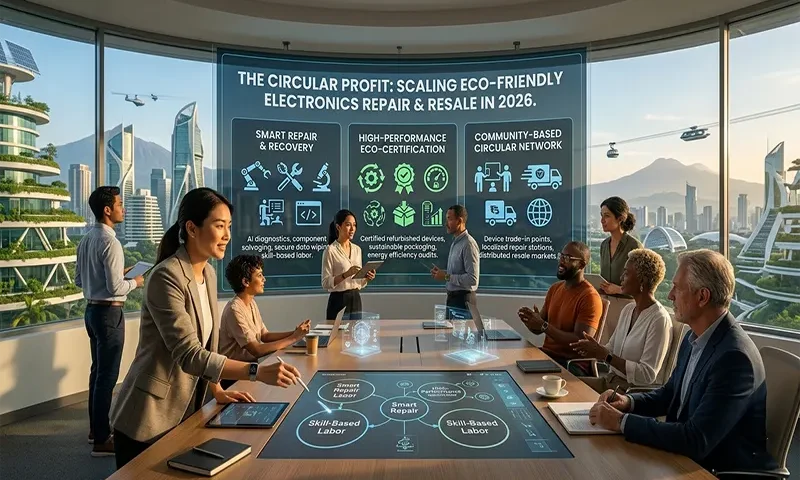
The year 2026 marks a definitive era in the electronics industry: the death of “planned obsolescence” and the birth of the Recommerce Revolution. For decades, the tech sector operated on a linear “take-make-waste” model, but a perfect storm of rising raw material costs, supply chain volatility, and the implementation of the EU’s Circular Economy Act has shifted the narrative. Today, extending the life of a device is no longer just a virtuous environmental goal; it is a $140 billion industrial strategy that is proving more profitable than new manufacturing in several key sectors.
The Legislative Tailwind: Right to Repair Compliance
The most significant catalyst for this shift is the Right to Repair Directive, which entered full force in July 2026. This landmark legislation has leveled the playing field for independent repair shops and small business owners. Manufacturers are now legally mandated to provide:
- Original Spare Parts: Access to genuine components at a non-discriminatory price.
- Repair Manuals and Schematics: Detailed blueprints that were previously “authorized-only.”
- Diagnostic Tools: Software keys and interfaces needed to reset parts after replacement.
This Right to Repair compliance has effectively lowered the barrier to entry. Entrepreneurs no longer have to resort to “part harvesting” from donor machines as their only source; they can now build reliable, scalable supply chains that mirror those of the original equipment manufacturers (OEMs).
Five High-Profit Circular Business Models
To succeed in 2026, entrepreneurs must move beyond the “generalist” repair shop model and embrace specialized, high-margin niches.
1. The “Niche Refurb” Specialist
While the smartphone market is saturated, massive opportunities exist in high-value, complex hardware. Focus on:
- Luxury Smart Appliances: High-end espresso machines or robotic vacuum cleaners.
- Specialized Medical Wearables: Pulse oximeters or sleep apnea monitors that are expensive to replace but simple for a specialist to refurbish.
These items often feature modular design components, allowing a specialist to achieve high throughput with minimal specialized tooling.
2. “Repair-as-a-Service” (RaaS) for B2B
The rise of permanent remote work has created a logistics nightmare for tech companies managing thousands of laptops, monitors, and ergonomic setups across different time zones. A RaaS business provides subscription-based maintenance for these distributed fleets. When an employee’s device breaks, the RaaS partner handles the reverse logistics, provides a temporary loaner, and repairs the original unit, ensuring the company’s “device churn” remains near zero.
3. Component Harvesting and Resale
Not every device can be saved. A component harvesting business operates as a “high-tech scrapyard.” By dismantling “beyond repair” units, you can salvage rare earth magnets, high-grade silicon chips, and OLED screens. These parts are then sold back to other repair shops or manufacturers who need recycled feedstock to meet their 2026 green procurement quotas.
4. The “Certified Pre-Loved” Marketplace
The primary barrier to buying used tech is a lack of trust. A “Certified Pre-Loved” platform adds a critical Trust Layer. By offering 12-month warranties, verified battery health certifications, and professional data sanitization, you can sell refurbished tech at a 30-40% premium over standard “used” prices.
5. Smart Home Legacy Support
As early smart home companies go bust or stop supporting older hardware, millions of “orphaned” devices remain in walls and ceilings. A specialized service that provides hardware fixes and custom firmware updates for these legacy systems is a high-demand niche, serving customers who are desperate to keep their $50,000 smart home installations functioning.
2026 Growth Sectors: Recommerce Potential
| Sector | Primary Driver | Projected 2026 Growth |
| Smartphones | Battery & Screen Standardization | 15% |
| Wearables | Medical Grade Sensor Refurbishment | 22% |
| Home Automation | Legacy Support & Software Patching | 30% |
| Computing | B2B Remote Fleet Management | 18% |
Operational Excellence: The Refurbishment Workflow
Operating a circular business requires a “Zero-Waste” mindset. The workflow begins with intake and a rigorous data sanitization process to ensure no trace of the previous owner remains. The repair is then conducted in a “Lean” environment, utilizing modular design principles to swap components quickly. Finally, the product is packaged in 100% compostable, plastic-free materials, reinforcing the eco-friendly brand identity from the moment the customer receives their “new-to-them” device.
Tech-Tip: AI-Driven Diagnostics
Use AI-powered diagnostic software to analyze circuit boards. These tools can identify micro-cracks or failing capacitors 10x faster than a human with a multimeter, significantly reducing the labor time—and increasing the profit margin—per repair.
Marketing Sustainability: “Premium and Responsible”
The era of “cheap and used” is over. Modern marketing for refurbished electronics should focus on being “Premium and Responsible.” Entrepreneurs are now using Carbon Avoidance Tracking to incentivize customers. For every purchase, the customer receives a certificate showing exactly how much CO2e and e-waste they prevented by not buying new. This gamifies sustainability and positions the refurbished device as a badge of honor for the conscious consumer.
The ROI of Repair: A Financial Reality Check
The financial math of the circular economy is compelling. When a company sells a new $1,000 laptop, the profit margin is often razor-thin due to manufacturing and marketing overhead. However, repairing that same laptop for a $200 fee—where $150 of that is skilled labor—yields a much higher percentage of pure profit.
- New Sale: $1,000 price – $850 cost = $150 Profit (15% Margin)
- Refurbished Sale: $600 price – $250 acquisition/parts = $350 Profit (58% Margin)
By focusing on the higher labor-to-part ratio, circular businesses can scale through expertise rather than raw inventory volume.
The Path to Net Zero
Electronics repair is no longer a peripheral “green” activity; it is the backbone of the global Net Zero 2030 goals. By keeping materials in the loop, we directly reduce the toxic burden of e-waste and the environmental devastation of mining. For the 2026 entrepreneur, the circular economy offers a rare alignment of interests: high-margin profitability, legislative protection, and a measurable contribution to the planet’s health. The future isn’t just about making new things; it’s about making things last.

